
Gaming is a normal part of childhood today. Whether your child is playing on a tablet, console, or PC, video games are not going away. And honestly, they do not need to. When managed well, gaming can support creativity, problem-solving, and even social connection.
But there is a thin line between healthy gaming and unhealthy dependency. Many parents feel stuck between wanting to support their child’s interests and worrying about too much screen time. The good news is that building healthy gaming habits for kids does not mean banning games entirely. It means setting smart boundaries and creating a balanced routine that works for your whole family.
This article walks you through everything you need to know, from understanding what healthy gaming actually looks like to practical steps you can start using today.
What Are Healthy Gaming Habits for Kids?
Healthy gaming habits refer to a balanced approach to playing video games where children enjoy games without it interfering with sleep, school, physical activity, or face-to-face relationships.
It is not just about limiting time. It is also about the type of games children play, the environment in which they play, and how gaming fits into the larger picture of a child’s day.
The Difference Between Casual Gaming and Problematic Gaming
A child with healthy gaming habits might play for one to two hours after completing homework, take breaks naturally, and switch to other activities without a struggle. A child with problematic gaming habits, on the other hand, may skip meals, lose sleep, and become angry or withdrawn when asked to stop.
Understanding this difference is the first step toward helping your child develop a positive relationship with games.
Key Benefits of Gaming When Done Right
Many people assume gaming is purely harmful. But research tells a more balanced story. When children play age-appropriate games in moderation, there are real cognitive and social benefits.
Cognitive and Educational Benefits
Video games often require quick thinking, planning, and problem-solving. Strategy games, for example, teach kids how to manage resources and think several steps ahead. Puzzle games build logical reasoning. Even action games have been shown to improve hand-eye coordination and reaction time.
Some educational platforms use game mechanics to teach math, reading, and science in ways that feel fun rather than like homework.
Social Benefits of Multiplayer Gaming
Online multiplayer games allow kids to collaborate with friends, make new connections, and learn teamwork. For children who are shy or introverted, gaming can actually be a low-pressure way to build friendships and communication skills.
Emotional and Creative Benefits
Games like Minecraft and Roblox give children a creative outlet. Building virtual worlds encourages imagination and spatial thinking. Role-playing games help kids explore different perspectives and emotions in a safe, fictional context.
How Healthy Gaming Habits Actually Work
Building good habits is not a one-time conversation. It is an ongoing process that involves structure, consistency, and open communication between parents and children.
Step 1: Set Clear and Consistent Time Limits
The American Academy of Pediatrics recommends that children aged 6 and older have consistent limits on the time they spend on screens, ensuring gaming does not take the place of adequate sleep, physical activity, and other essential behaviors.
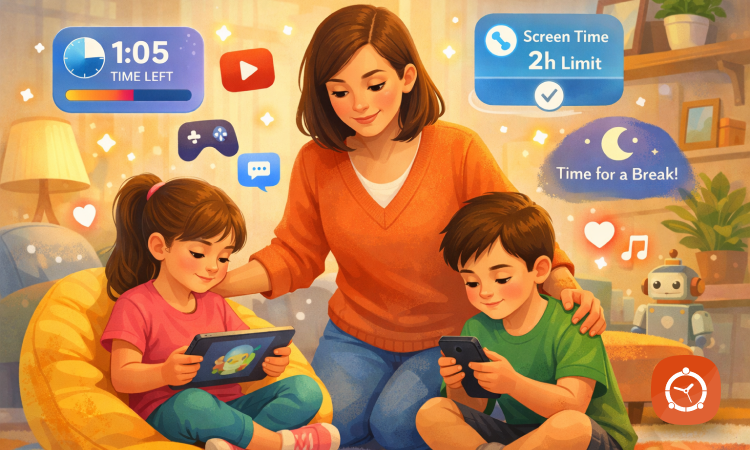
A good starting point for school-age children is one to two hours of recreational screen time per day. For teenagers, the limits can be slightly more flexible, but gaming should never crowd out sleep or schoolwork.
Use a timer or parental control settings to make limits automatic. This removes the argument from the equation because the rules are set in advance.
Step 2: Choose Age-Appropriate Games
Not every game is suitable for every child. Always check the ESRB rating before allowing your child to play a new game. Games rated E for Everyone or E10 are designed with younger audiences in mind. Games rated M for Mature contain content meant for adults and are not appropriate for young children.
Beyond ratings, consider the content itself. Games with heavy violence, online chat features, or in-game purchases need extra parental scrutiny.
Step 3: Create a Gaming Schedule
Rather than letting gaming happen spontaneously throughout the day, build it into a daily schedule. For example, gaming can be allowed from 4:30 to 6:00 PM after homework is done and before dinner. On weekends, an extra session in the morning might be appropriate.
When children know exactly when they can play, they are less likely to beg or bargain for more time.
Step 4: Set Up Gaming in a Common Area
Keep gaming devices in shared spaces like the living room rather than in a child’s bedroom. This allows you to monitor what your child is playing, who they are talking to online, and how long they have been at it.
Bedroom gaming, especially at night, is strongly linked to poor sleep quality in children and teenagers.
Step 5: Talk About Games With Your Child
Show genuine interest in what your child is playing. Ask about the story, the characters, the challenges. When children feel that gaming is a shared interest rather than a guilty pleasure, they are more likely to be open about what they are doing online.
This also opens the door for conversations about online safety, in-game purchases, and interacting with strangers.
Advantages and Limitations of Gaming for Kids
Advantages
Gaming teaches children problem-solving skills in an interactive environment that textbooks simply cannot replicate. It builds patience, since most games require repeated attempts before success. It also provides a healthy stress outlet after a long school day.
Multiplayer gaming fosters teamwork and communication. Children learn to coordinate, negotiate, and support each other to achieve a common goal.
Limitations and Real Risks
The biggest risk is excessive screen time leading to sedentary behavior, poor sleep, and reduced time for physical activity and real-world socializing. The World Health Organization classifies gaming disorder as a condition where gaming takes priority over other activities to the point of causing significant harm.
In-game purchases and loot boxes are another concern. Many games are designed to encourage spending, and children may not fully understand the real-world value of money they are spending digitally.
Online interactions carry risks too. Children can be exposed to inappropriate content, cyberbullying, or contact from strangers if games are not properly monitored.
Best Practices and Tips for Parents
Create a Family Tech Agreement
Sit down together and write out a simple set of rules. Include daily time limits, which games are allowed, where gaming happens, and what happens if the rules are broken. When children help create the rules, they feel ownership and are more likely to follow them.
Use Parental Controls on Every Device
Every major gaming platform, including PlayStation, Xbox, Nintendo Switch, and PC, has built-in parental control features. These let you limit playtime, restrict game ratings, block online communication, and control spending.
Set these up the moment a new device enters your home. Do not wait until a problem arises.
Balance Gaming With Physical Activity
Make physical activity non-negotiable. Children need at least 60 minutes of moderate to vigorous physical activity every day according to the CDC. Gaming sessions should come after, not instead of, outdoor play, sports, or exercise.
Reward Responsible Gaming
When your child follows the rules consistently, acknowledge it. Positive reinforcement works far better than punishment. A child who is trusted with gaming time is more likely to self-regulate over time.
Model Healthy Screen Use Yourself
Children pay close attention to what adults do. If you are constantly on your phone or watching TV for hours, it sends a mixed message. Model the balanced screen behavior you want your child to develop.
Common Mistakes Parents Make
Setting Rules Without Explanation
Telling a child “no gaming today” without a reason creates frustration and resistance. Always explain the why behind your rules. Children who understand the reasoning are more likely to cooperate.
Going Cold Turkey Without a Plan
Suddenly removing gaming entirely often backfires. Children may become secretive, anxious, or resentful. Instead, reduce screen time gradually and replace it with other engaging activities.
Ignoring Game Content
Many parents focus only on time limits and ignore what their child is actually playing. A violent or online game for 30 minutes can be more harmful than two hours of an age-appropriate single-player game. Always know what your child is playing.
Using Gaming as a Babysitter
Handing a child a device to keep them quiet may seem harmless in the short term, but it trains them to reach for a screen whenever they are bored. Boredom is actually healthy for children as it encourages creativity and independent thinking.
Not Having a Consistent Enforcement
If screen time rules are enforced only sometimes, children will constantly test the limits. Consistency is what makes boundaries meaningful.
Frequently Asked Questions
How much gaming time is appropriate for kids?
The American Academy of Pediatrics recommends no more than one to two hours of recreational screen time per day for children aged 6 and older. The emphasis should be on ensuring that gaming does not replace sleep, physical activity, or face-to-face interaction.
At what age can kids start playing video games?
Most child development experts suggest that structured gaming can begin around age 5 or 6, with close parental supervision and age-appropriate games. Before age 2, screen time should be avoided except for video chatting. Between ages 2 and 5, limit screen use to one hour per day of high-quality programming.
How do I know if my child is addicted to gaming?
Warning signs include neglecting schoolwork, losing interest in other hobbies, becoming irritable or aggressive when gaming is limited, lying about how much they play, and choosing gaming over spending time with family or friends. If several of these signs are present consistently, consult a pediatrician or child psychologist.
Are all video games bad for kids?
No. Research shows that age-appropriate games played in moderation can benefit children cognitively, socially, and even emotionally. The key factors are game content, time spent playing, and whether gaming is balanced with other healthy activities.
How can I get my child to follow screen time rules?
Involve them in creating the rules. Use parental controls to reinforce limits automatically. Offer alternative activities that are equally engaging. Be consistent, and use positive reinforcement when your child respects the boundaries.
What are the best types of games for children?
Games that encourage creativity, problem-solving, and cooperation are generally best. Examples include Minecraft for creative building, educational platforms like PBS Kids games, cooperative multiplayer games that require teamwork, and story-driven games with age-appropriate themes.
Conclusion
Building healthy gaming habits for kids is not about being the strictest parent on the block. It is about being the most intentional one. Gaming is part of modern childhood, and when approached thoughtfully, it can be a genuinely positive experience for your child.
The strategies in this article, from setting clear time limits and choosing age-appropriate games to having open conversations and using parental controls, give you a practical foundation to work from. You do not need to figure it all out at once. Start with one or two changes and build from there.
Your child does not need to choose between being a gamer and being healthy, happy, and well-rounded. With the right boundaries in place, they can be all of those things at once.
If you found this guide helpful, explore further resources on child development and digital wellness to keep learning how to support your child in today’s screen-heavy world.