
If you have a child at home, chances are gaming is already part of their daily life. Whether it is a tablet game before bedtime, an online multiplayer session with friends, or a console game on the weekend, video games have become one of the most common childhood activities of this generation.
As a parent, it is natural to have questions. Is gaming harming my child? How much screen time is too much? Are there any real benefits? How do I keep them safe online?
This guide answers all of those questions honestly. It covers everything from the developmental effects of gaming to practical tips for setting boundaries, choosing age-appropriate games, and keeping children safe in online environments. Whether your child is just starting out or already a dedicated gamer, this guide will help you stay informed and in control.
What Is Children and Gaming?
Children and gaming refers to the relationship between young people, typically ages 3 to 17, and video games across all platforms including consoles, mobile devices, PCs, and tablets.
Gaming has evolved dramatically over the past decade. Today’s games are not just simple puzzles or arcade-style challenges. Many are rich, social, and story-driven experiences that require teamwork, strategy, and creative thinking. At the same time, concerns around screen time, online safety, and gaming addiction have grown alongside the industry itself.
Understanding this relationship clearly is the first step every parent needs to take before making decisions about their child’s gaming habits.
How Gaming Affects Child Development
Not all screen time is created equal. Research shows that the impact of gaming on children depends heavily on the type of game, the amount of time spent, the child’s age, and whether parents are involved.
Cognitive Development
Many games require children to solve problems, plan ahead, and think critically. Strategy games, puzzle games, and even certain action games have been linked to improvements in memory, attention span, and spatial reasoning.
A child who regularly plays building or strategy games is often practicing skills like planning, resource management, and logical thinking without even realizing it.
Social Development
Multiplayer games allow children to collaborate with peers, communicate in real time, and build friendships. For some children, especially those who struggle socially in school, online gaming communities provide a sense of belonging.
However, online interaction also carries risks such as exposure to inappropriate language, cyberbullying, and contact with strangers. This is why parental supervision remains important even in social gaming environments.
Emotional Development
Games can teach children how to handle frustration, manage defeat, and celebrate progress. Many modern games are designed with failure as a core mechanic, which builds resilience when approached in the right way.
On the other hand, games designed to maximize engagement through reward loops can lead to emotional dependency if boundaries are not set early.
Key Benefits of Gaming for Children
When managed properly, gaming offers several genuine developmental benefits that parents should be aware of.
Problem-Solving Skills: Games consistently challenge players to find solutions under pressure. This translates into stronger analytical thinking in real-world situations.
Hand-Eye Coordination: Action and sports games require precise timing and coordination between what a child sees and how they respond physically. Studies in pediatric development have noted improvements in fine motor skills among children who game regularly.
Creativity and Imagination: Games like Minecraft, Roblox, and similar sandbox titles give children nearly unlimited creative freedom. Many children use these platforms to build entire worlds, design characters, and tell their own stories.
Stress Relief: For older children and teenagers, gaming can serve as a healthy emotional outlet after a demanding school day, provided usage is balanced with other activities.
Digital Literacy: Growing up with games builds comfort and confidence with technology, which is increasingly important for academic and professional success in the modern world.
Teamwork and Communication: Cooperative multiplayer games teach children how to work toward a shared goal, listen to teammates, and communicate clearly under pressure.
How Parental Controls and Game Ratings Work
Before diving into rules and screen time limits, it helps to understand the tools already available to you.
Understanding Game Ratings
Most countries have official game rating systems that help parents identify age-appropriate content.
In the United States, the Entertainment Software Rating Board (ESRB) assigns ratings such as EC (Early Childhood), E (Everyone), E10+ (Everyone 10 and older), T (Teen), M (Mature 17+), and AO (Adults Only).
In Europe, the Pan European Game Information (PEGI) system uses age ratings of 3, 7, 12, 16, and 18. Each rating comes with content descriptors explaining exactly what kind of material is present, such as violence, language, or online interaction.
Always check the rating and content descriptors before purchasing or downloading a game for your child.
Using Built-In Parental Controls
Every major gaming platform in 2026 includes parental control features. Here is a quick overview of what each platform offers.
PlayStation and Xbox both allow parents to set playtime limits, restrict online communication, block purchases, and filter game content by age rating directly from a parent dashboard.
Nintendo Switch parental controls are managed through a dedicated smartphone app, giving parents real-time usage data and the ability to set bedtime alarms that pause gameplay automatically.
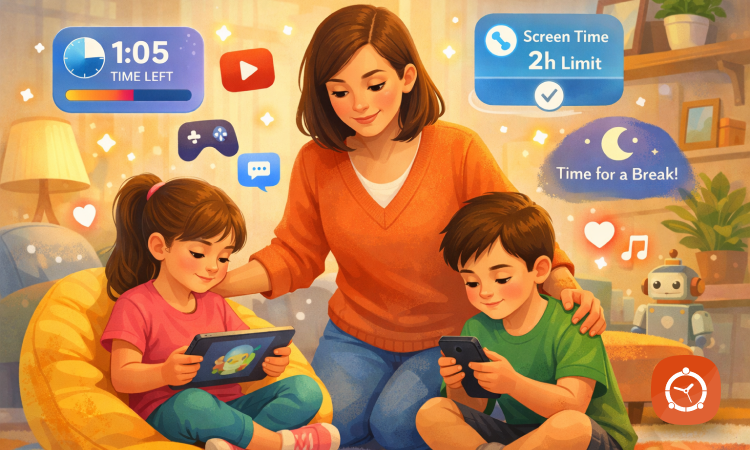
Mobile devices running iOS or Android include Screen Time and Digital Wellbeing features respectively, which allow parents to set daily limits per app, restrict in-app purchases, and block access to certain content categories.
PC gaming platforms like Steam also offer family view settings that require a PIN to access unrestricted content.
Setting these controls up takes less than thirty minutes and provides a strong foundation for healthy gaming habits without requiring constant manual supervision.
How to Set Healthy Screen Time Limits
One of the most common concerns parents have is how much gaming is too much. The answer depends on the child’s age, overall lifestyle, and whether gaming is displacing more important activities.
Recommended Screen Time by Age
The American Academy of Pediatrics (AAP) offers these general guidelines for screen time, including gaming.
Children under 18 to 24 months should avoid screen time other than video chatting. Children aged 2 to 5 years should be limited to one hour per day of high-quality content. Children aged 6 and older should have consistent limits that ensure gaming does not interfere with sleep, physical activity, homework, and family time.
For teenagers, context matters more than raw hours. A teen who completes schoolwork, stays active, sleeps well, and maintains social relationships outside gaming is generally not at risk even if they game for two to three hours daily.
Practical Ways to Manage Screen Time
Set clear daily or weekly gaming limits and communicate them openly with your child. Use platform parental controls to enforce those limits automatically rather than relying solely on manual reminders.
Create gaming-free zones and times, such as during meals, one hour before bedtime, and during homework hours. Make gaming a reward that follows responsibilities rather than a default activity.
Involve your child in creating the rules. Children who help set boundaries are far more likely to respect them.
Online Safety for Gaming Children
Online gaming introduces children to a world far larger than their immediate social circle, which brings both opportunity and risk.
Common Online Risks
Cyberbullying is one of the most reported issues in online gaming. Children can be targeted by other players through hostile language, exclusion from groups, or deliberate sabotage during gameplay.
Predatory contact is a serious concern in games with open chat features. Some adults use gaming platforms to build trust with children before attempting to move communication to private channels.
Inappropriate content including violent language, adult humor, and disturbing imagery can appear in user-generated content, player-created levels, or in-game chat channels even in games rated for younger audiences.
In-game purchases and microtransactions can lead children to spend real money, sometimes without fully understanding the financial implications.
How to Keep Your Child Safe Online
Enable privacy settings on every account your child uses. Turn off or restrict public chat features for younger children. Teach your child never to share personal information including their real name, school, location, or phone number with online contacts.
Use a family email address for all gaming account registrations rather than your child’s personal email. Review friend lists regularly and have open conversations about who your child is talking to online.
Create an environment where your child feels safe reporting uncomfortable interactions to you without fear of losing their gaming privileges.
Advantages and Limitations of Gaming for Children
Like most activities, gaming has a genuine upside and a real downside. An honest view of both helps parents make better decisions.
Advantages
Gaming builds real skills including problem-solving, creativity, coordination, and digital literacy. It provides social connection and community, particularly for children who are introverted or geographically isolated. It can be a positive stress outlet and a source of achievement and confidence.
Educational games, when chosen carefully, can supplement classroom learning in subjects like mathematics, science, history, and language arts.
Limitations
Excessive gaming can displace sleep, physical activity, face-to-face social interaction, and academic effort. Some games are specifically designed to maximize engagement through psychological reward loops, which can make it genuinely difficult for children to stop playing.
Online environments carry safety risks that require active parental oversight. Not all games are appropriate for all ages, and content ratings do not always capture everything a child may encounter in user-generated portions of a game.
Children with certain conditions including ADHD or anxiety may be more vulnerable to problematic gaming patterns and may require more structured boundaries.
Best Practices and Tips for Parents
Here are practical, proven strategies that child development experts and experienced parents recommend.
Play games with your child at least occasionally. Direct participation helps you understand what your child is experiencing, builds connection, and gives you natural insight into game content and online interactions.
Keep gaming devices in shared family spaces rather than bedrooms, especially for younger children. This makes natural supervision easier without requiring constant monitoring.
Ask your child to teach you about the games they enjoy. Showing genuine interest builds trust and opens communication about gaming experiences including any negative ones.
Balance gaming with physical activity, creative play, reading, and face-to-face social time. No single activity, however engaging, should dominate a child’s day.
Research games before purchasing or allowing downloads. Websites like Common Sense Media provide detailed, parent-focused reviews that go beyond age ratings to describe specific content.
Revisit and adjust screen time rules as your child grows. What works for a seven-year-old will not suit a thirteen-year-old, and rules should evolve alongside your child’s maturity and responsibilities.
Common Mistakes Parents Make Around Gaming
Being completely restrictive without explanation. Banning all gaming without discussing why tends to increase desire and resentment. It also removes the opportunity to teach healthy self-regulation.
Ignoring the content entirely. Assuming a game is appropriate simply because it is animated or appears colorful is a common error. Many games aimed at teenagers contain mature themes, online chat features, or aggressive monetization that younger children should not encounter.
Using gaming as a babysitter without oversight. Gaming is not inherently harmful, but unmonitored gaming over long periods leaves children vulnerable to both content risks and unhealthy usage patterns.
Reacting with panic instead of conversation when problems arise. If your child encounters something disturbing online or shows signs of excessive gaming, an open conversation is almost always more effective than immediate punishment.
Overlooking in-game spending. Many free-to-play games are designed to encourage purchases. Setting up payment methods that require parent approval, and discussing the real value of in-game currency with your child, prevents unexpected charges and teaches financial awareness.
Frequently Asked Questions
At what age can children start playing video games?
Simple, age-appropriate games on tablets or consoles can be introduced from around age three with parental supervision. The key is choosing games designed for that age group, limiting session length, and playing alongside your child to guide the experience.
How much gaming per day is healthy for a child?
For children aged 6 and older, most pediatric guidelines suggest no more than one to two hours on school days and up to three hours on weekends, provided all other responsibilities are met. Quality and content matter as much as quantity.
Can gaming become addictive in children?
The World Health Organization recognized Gaming Disorder as a clinical condition in 2019. While true addiction is relatively rare, problematic gaming patterns, where gaming consistently interferes with sleep, school, and social life, are more common and worth addressing early. If you notice these signs, consulting a pediatrician or child psychologist is a sensible step.
Are violent video games harmful to children?
Research on this topic is ongoing and somewhat mixed. Most child development experts agree that games with graphic violence are inappropriate for young children and that sustained exposure to violent content can influence attitudes in vulnerable individuals. Following age ratings and monitoring content remains the safest approach.
How do I talk to my child about online gaming safety?
Frame the conversation around trust and protection rather than punishment. Explain why sharing personal information online is risky using age-appropriate examples. Encourage your child to come to you if anything online makes them uncomfortable, and make sure they know they will not lose gaming access simply for reporting a problem.
What are the best games for children in 2026?
Age-appropriate titles consistently praised for educational or creative value include Minecraft, Mario Kart, Animal Crossing, Lego series games, and various titles on platforms like PBS Kids and Khan Academy Kids for younger children. Common Sense Media remains one of the most reliable resources for finding suitable games by age group.
Conclusion
Gaming is not the enemy of a healthy childhood. When approached thoughtfully, it can be a source of learning, creativity, friendship, and genuine joy for children of all ages. The challenge for parents is not to eliminate gaming but to shape it into a positive and balanced part of their child’s life.
That means understanding the games your child plays, using the parental tools available to you, setting clear and consistent boundaries, and keeping communication open. It means treating gaming with the same informed attention you would give any significant activity in your child’s life.
The parents who navigate this well are not the ones who ban everything or allow everything. They are the ones who stay curious, stay involved, and stay willing to adjust as their child grows.
Take the time to explore the resources available to you, review the games your child enjoys, and have honest conversations about how gaming fits into your family’s values. That combination of awareness and engagement is what makes the difference.